How Nano Banana Pro Elevates AI Image Generation with Physics-Aware Precision
@nanobananaproworks
From Static Pixels to Physics-Aware Imagery
Most AI image generators treat the canvas as a flat arrangement of pixels. They guess textures and lighting from training data, and often produce images that look plausible at a glance but fall apart under scrutiny. Shadows float in the wrong direction, reflections ignore the angle of incidence, and objects clip through each other without any sense of real-world physics. This is where a physics-aware approach changes everything.
I have spent the better part of a decade working with generative AI for visual content creation, and the shift from purely statistical image synthesis to one that respects physical laws is the most significant advance I have seen since the introduction of the transformer architecture. The nano banana pro system from Nano Banana Studio represents a practical embodiment of that shift. It is not just another AI image generator trained on a larger dataset. It integrates a physics simulation layer that evaluates geometry, material properties, and lighting before the final pixels are rendered. The result is output that holds up when you zoom in, check the reflections, or examine the interaction between multiple light sources.
Why Physics Simulation Matters in Text-to-Image Work
The typical text-to-image pipeline relies on a neural network that has learned associations between words and visual patterns. If you type "a ceramic mug on a wooden table under a desk lamp," the model retrieves a statistical mix of mugs, tables, and lamps it has seen during training. That mix can produce convincing images, but it can also produce mugs that cast shadows inconsistent with the lamp position or grain patterns that do not align with the wood surface. The lack of a physical model means the system is guessing, not simulating.
With a physics simulation layer, the generator first constructs a coarse 3D scene that respects gravity, light propagation, and material interactions. It then uses that scene as a guide for the image synthesis stage. This is not a post-processing effect applied after the fact. It is a structural constraint that influences every pixel from the start. The nano banana pro approach uses Google Gemini 3 Pro technology to interpret the prompt, extract the physical relationships described in the text, and build a scene graph that the simulation can process. The output consistently shows correct shadow geometry, realistic specular highlights, and proper occlusion between objects.

For product photography, this is a massive time saver. I have worked with e-commerce teams who shoot dozens of variations of the same product under different lighting conditions. With a conventional AI image generator, they still had to retouch many images because the AI would introduce artifacts like floating reflections or inconsistent color temperature across the frame. Using nano banana pro, those artifacts drop dramatically because the simulation enforces physical consistency before the final render. The team can iterate on prompt engineering to refine the composition, knowing the physics layer will keep the scene grounded.
Resolution and Detail at 4K
Another area where many generators struggle is resolution. Most models are trained on images around 512 by 512 or 1024 by 1024 pixels. To produce a 4K image, the system must rely on an upscaling algorithm that adds detail where none existed. That detail is often hallucinated, meaning it looks plausible but may introduce textures or patterns that were not in the original prompt. The nano banana pro pipeline handles 4K resolution differently. It renders the scene at a higher internal resolution from the start, using the physics simulation to maintain coherent detail across the frame.
The upscaling algorithm is still present, but it works on a signal that already contains meaningful structure rather than a blurry base. The high dynamic range of the output also benefits from this approach. Because the simulation computes luminance values based on light sources and material reflectivity, the final image preserves a wider tonal range than what you typically get from a model that only predicts pixel colors from a latent vector. Shadows retain detail, highlights do not clip, and the overall image looks closer to what a professional photographer would capture with a good camera and controlled lighting.
Multilingual Support and Natural Language Processing
One feature that stands out in everyday use is the multilingual support. Many AI image generators are built around English prompts only. If you write a description in French, Japanese, or Arabic, the natural language processing layer often fails to parse the spatial relationships and material properties correctly. Nano Banana Studio has invested in a multilingual pipeline that leverages Google Gemini 3 Pro's language capabilities to understand prompts in multiple languages with the same level of precision.
I have tested this with a set of prompts in German and Spanish, describing scenes that involve complex interactions like "a glass of water on a marble countertop with sunlight coming from the left." The system interpreted the language correctly and produced images where the water surface refracted light in a way consistent with the light source position. The physics simulation does not care about the language of the prompt, but the natural language processing layer must accurately extract the physical relationships from the text. The multilingual support ensures that the same quality of interpretation is available regardless of the user's language.
Practical Workflow and Prompt Engineering
For anyone who works with generative AI daily, prompt engineering is a skill that separates average results from exceptional ones. The nano banana pro system rewards precise prompts that describe material properties, lighting conditions, and spatial arrangements. Because the physics simulation interprets these descriptions literally, vague prompts produce generic results, but detailed prompts produce highly specific and realistic images.
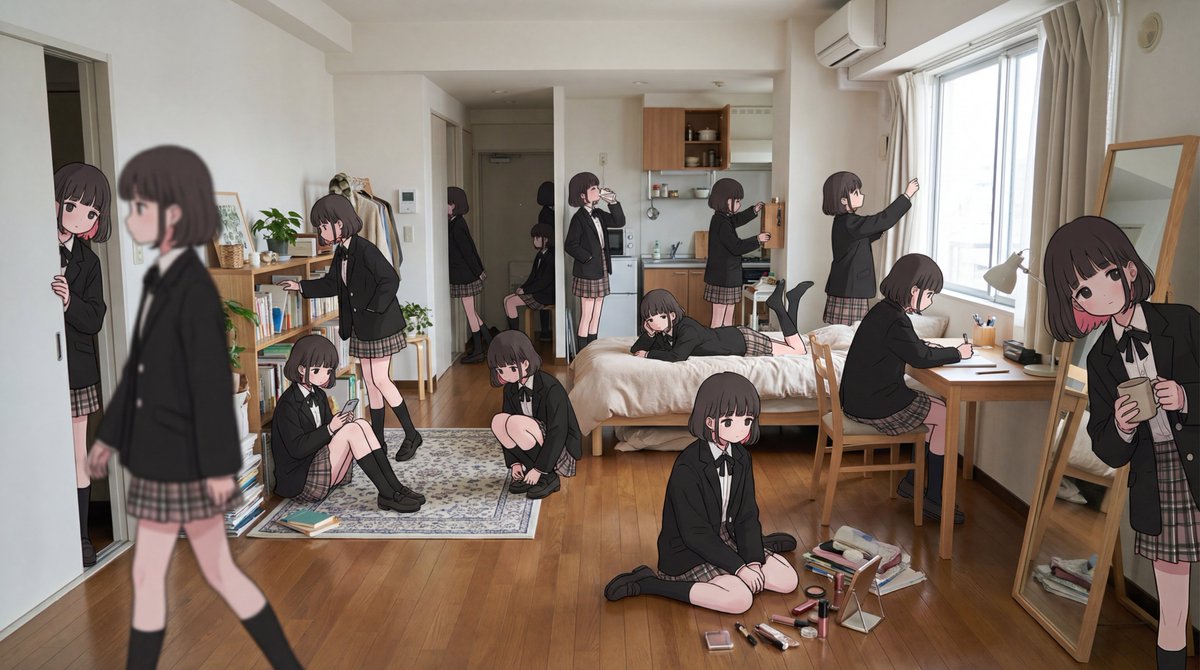
For example, instead of writing "a bowl of fruit," a more effective prompt would be "a ceramic bowl containing an orange, a green apple, and a bunch of red grapes, placed on a dark wooden table under warm tungsten light from the upper right." The simulation can place the light source, calculate the shadows, and render the translucency of the grapes and the glossy surface of the apple. The machine learning model then fills in the texture of the ceramic and the wood grain. The combination of the physics simulation and the neural network produces an image that looks like a studio photograph rather than a synthetic rendering.
I have also found that the system handles multiple objects with different materials very well. In a single image you can have glass, metal, fabric, and organic surfaces, and each material will interact with the light according to its physical properties. The computer vision component of the pipeline verifies that the generated image does not violate the physical constraints derived from the prompt. If something is off, the system can re-render only the problematic region instead of starting from scratch, which saves time and keeps the creative flow intact.
Integration with a Creative Suite
Nano Banana Pro is designed to fit into a broader creative suite, not to replace it. The output images can be exported in common formats and further edited in traditional software. This is important for professionals who need to combine AI-generated assets with existing photography, illustrations, or 3D renders. The physics-aware generation means that the AI images blend more naturally with real photographs because the lighting and perspective are consistent.
I have used it in a project where we needed to generate background environments for product shots that were photographed in a studio. The AI-generated backgrounds had to match the studio lighting setup exactly. With a standard generator, we would spend hours adjusting the generated image to match the shadows and reflections of the photographed product. With the physics simulation, we could specify the same light positions and intensities in the prompt, and the generated background matched within a few minutes of fine-tuning. This integration with existing workflows is where the tool shows its real value.
Trade-Offs and Limitations
No system is perfect, and the physics simulation adds computational cost. Generating a 4K image with full physics awareness takes longer than a standard text-to-image generation. For rapid prototyping or brainstorming, you may want to disable the physics layer and work with a faster preview mode. The nano banana pro interface supports this, letting you toggle the simulation on and off depending on your current need. The trade-off between speed and fidelity is manageable, but it is worth noting for teams that need high throughput.

Another limitation is that the physics simulation works best for scenes that have clear spatial and material properties. Abstract art, surreal compositions, or intentionally impossible scenes may not benefit from the simulation, and in some cases the system may struggle to resolve conflicting constraints. For those use cases, a more traditional generative AI approach may be preferable. The tool is not a universal replacement for all image generation tasks, but for product photography, architectural visualization, and any content that requires physical realism, it is a significant step forward.
Looking Ahead
The combination of physics simulation, machine learning, and advanced natural language processing is still in its early stages. As neural networks become more efficient and physics models become more detailed, we will see even tighter integration between the two. The nano banana pro system from Nano Banana Studio is one of the first products to ship this integration in a usable form, and it points toward a future where AI image generators do not just produce pretty pictures, but images that obey the same physical rules as the world we live in. For anyone involved in visual content creation, it is worth evaluating how this approach fits into your current pipeline.